Full grain, top grain, genuine, bonded: leather labels sound like a ranking, but most shoppers are never told what the words mean. The terms describe which part of the hide is used and how much the surface has been altered. Once you know that, you can judge a jacket in a few seconds. Here is a plain-English guide.
How a hide becomes leather
A raw hide is too thick to use whole, so tanneries split it into layers. The outer layer, where the hair grew, carries the grain: a dense web of fibres that is the strongest part of the hide. The layers underneath are looser and weaker. The grade names describe which layer you are getting and what was done to its surface. For background, see the overview of leather types and tanning on Wikipedia.
Leather grades at a glance
| Grade |
What it is |
Look and feel |
Durability |
| Full grain |
The outer layer with the natural surface left intact |
Visible pores and natural marks; develops a rich patina |
Highest |
| Top grain |
The outer layer, lightly sanded or buffed and then finished |
Smoother and more uniform; resists stains better |
Very good |
| Corrected grain |
Outer layer sanded more heavily, with an embossed grain pattern and pigment coat |
Very even; less natural character |
Good |
| Split leather / suede |
The lower layers of the hide |
Soft nap (suede) or coated to imitate grain |
Moderate |
| Bonded leather |
Leather scraps ground up and glued to a backing |
Uniform, plastic-like |
Low |
What is full grain leather?
Full grain leather keeps the complete outer surface of the hide. Nothing is sanded away, so the tight fibre structure stays whole. That makes it the strongest and longest-lasting grade. It also means natural marks remain visible: small scars, wrinkles and variations in pore size. These are signs of authenticity, not flaws.
Full grain leather starts out firmer and softens with wear. Over the years it develops a patina, a deepening of colour and sheen where the jacket is handled and flexed most. Many people buy leather for exactly this reason.
What is top grain leather?
Top grain leather comes from the same outer layer, but the surface is lightly sanded to remove marks and then given a finish coat. The result is a cleaner, more even look and a softer hand from day one. The finish also makes it a little more resistant to stains and water spots.
The trade-off is that sanding removes a small amount of the strongest fibres and the finish slows the development of patina. Top grain is still a strong, long-lasting material and is widely used for jackets because it is consistent and comfortable.
Full grain vs top grain: which is better for a jacket?
For bags, belts and boots, full grain is usually the clear winner because those items take hard knocks. Jackets are different: they need to drape and move with you.
- Pick full grain if you want maximum durability and visible natural character, and you do not mind a break-in period. It suits heavier biker and work-style jackets.
- Pick top grain if you want a smooth, even surface and softness straight away. It suits cleaner styles such as cafe racers, bombers and blazers.
The type of hide matters at least as much as the grade. A lambskin jacket will always feel softer and lighter than a cowhide jacket of the same grade, while cowhide will always be tougher. If you are choosing between styles, our guide to leather jacket styles every man should own explains which hide suits which cut.
Where “genuine leather” fits in
“Genuine leather” means the product is real leather. It does not tell you the grade. Some brands use it for excellent hides; others use it for coated split leather. Treat it as a starting point and look for more detail: the animal (lambskin, cowhide, sheepskin), the finish and the thickness. We compare real and synthetic materials in detail in genuine leather vs faux leather.
How to judge leather quality yourself
- Study the surface. Natural pores and small irregularities point to full or top grain. A perfectly repeating texture means it has been embossed.
- Feel the weight and thickness. Good jacket leather feels substantial for its type and consistent from panel to panel.
- Bend a sleeve. Quality leather forms fine, soft wrinkles. A heavy coating creases sharply or looks like plastic.
- Check the edges. Inside a pocket you should see dense fibres, not a thin film over fabric.
- Look at the build. Even stitching, smooth zips and a properly attached lining tell you how much care went into the whole jacket.
Caring for full grain and top grain leather
Both grades need the same simple routine: wipe off dust and dirt with a soft damp cloth, let rain dry naturally away from heat, condition once or twice a year and store the jacket on a wide, padded hanger. Full grain leather, with its open pores, benefits most from regular conditioning. The full routine is in our leather jacket care guide.
Shop real leather jackets
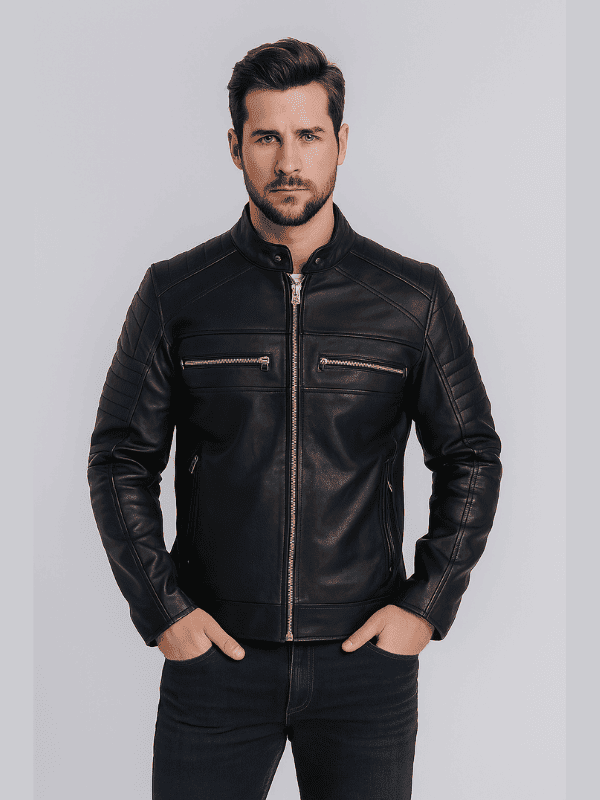
Jasperz Wear jackets are handmade to order in real lambskin and cowhide, in sizes XS to 5XL or to your own measurements. Explore men’s real leather jackets, women’s leather jackets and leather coats, or start with a classic like the men’s quilted black cafe racer. If you have a question about the leather used on a particular jacket, ask us before you order.
Frequently asked questions
Is full grain leather better than top grain?
Full grain is stronger and ages with more character. Top grain is smoother, softer at first and more stain resistant. For a jacket, both are good choices; the better one is the one that matches the look and feel you want.
Is top grain leather real leather?
Yes. Top grain is real leather from the outer layer of the hide, with a lightly sanded and finished surface.
Does full grain leather scratch easily?
It can show light surface scratches because it has no heavy coating. Most can be rubbed out with a fingertip or a little conditioner, and over time they blend into the patina.
What is the lowest grade of leather?
Bonded leather, which is made from leather scraps glued to a backing and coated. It looks like leather at first but wears out far sooner than any hide-based grade.
Is lambskin full grain or top grain?
Lambskin describes the animal, not the grade. Lambskin can be finished as full grain or top grain; in both cases it is softer and lighter than cowhide.