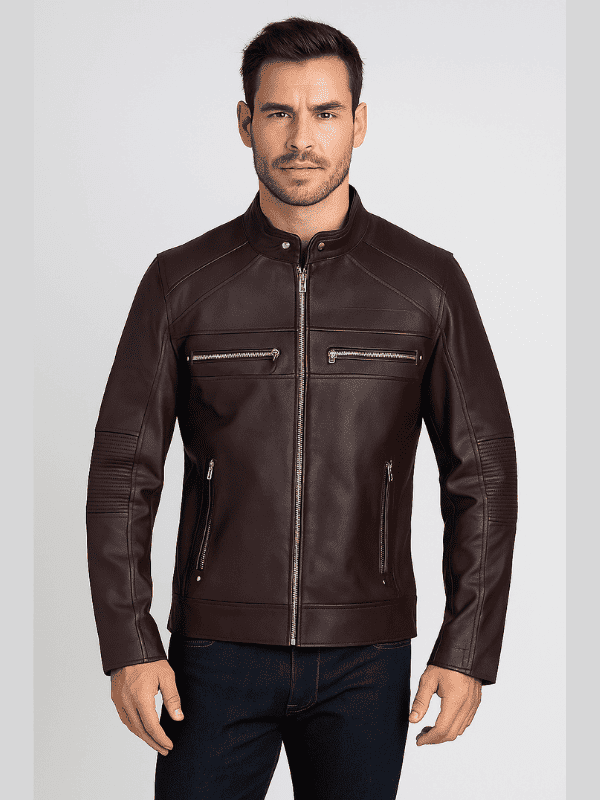
Two jackets can look almost the same on a hanger and cost very different amounts. One is real leather, the other is faux (also sold as PU, vegan or synthetic leather). The right choice depends on how long you want the jacket to last, how you will wear it and what you want to spend. This guide compares the two honestly, so you can pick the one that fits your life.
Quick comparison: genuine leather vs faux leather
| |
Genuine leather |
Faux (PU) leather |
| Made from |
Tanned animal hide, usually lambskin, sheepskin or cowhide |
A fabric base coated with polyurethane (PU) or PVC |
| Lifespan |
Many years, often decades with basic care |
Usually a few years of regular wear before the coating cracks or peels |
| How it ages |
Softens and develops a patina |
Looks the same until the surface starts to wear out |
| Feel |
Supple, slightly uneven grain, warms to the body |
Smooth and uniform, a little cooler and stiffer |
| Breathability |
Breathes through natural pores |
Low: the plastic coating traps heat and moisture |
| Weight |
Heavier (cowhide) to light (lambskin) |
Light |
| Care |
Wipe, condition once or twice a year, keep away from heavy rain |
Wipe clean with a damp cloth |
| Price |
Higher up front, lower cost per year of wear |
Lower up front |
| Animal products |
Yes |
No |
What “genuine leather” actually means
In everyday speech, “genuine leather” simply means the jacket is made from real animal hide and not plastic. On product labels the phrase is sometimes used for lower grades of real leather too, which is why two “genuine leather” jackets can feel so different. What matters more than the phrase is the type of hide and how it was finished:
- Lambskin is thin, soft and light. It drapes well and feels broken-in from the first wear. It is the usual choice for fashion jackets and slim fits.
- Cowhide is thicker and tougher. It takes longer to soften but handles hard use, which is why classic biker jackets are made from it.
- Sheepskin with the wool left on is shearling, used for B-3 style bombers and winter coats.
- Suede is the underside of the hide, brushed to a soft nap.
In the United States, the Federal Trade Commission’s Leather Guides say a product should not be described as leather unless it is, and that imitation leather must be disclosed. If a listing is vague about the material, ask the seller before you buy.
What faux leather is made of
Faux leather is a woven or knitted fabric, usually polyester, with a plastic coating embossed to look like grain. Most jackets today use polyurethane (PU), which is softer and more flexible than the older PVC type. “Vegan leather” is a marketing name for the same family of materials, although a few newer versions use plant-based content in the coating.
Good PU leather looks convincing and has become much better over the last decade. Its weak point is time: the coating is a thin layer, and with repeated bending at the elbows, collar and cuffs it eventually cracks or flakes. Once that starts it cannot really be repaired.
Durability and cost per wear
Real leather is a single thick material, so scuffs and creases become part of its character and most damage can be conditioned or repaired. A well-kept leather jacket can be worn for decades.
A faux leather jacket is cheaper to buy, but if it needs replacing every few years the saving shrinks. A simple way to compare is cost per year: divide the price by the number of years you realistically expect to wear it. For a jacket you plan to wear every autumn and winter, real leather usually wins. For a trend piece or a costume you will wear a handful of times, faux is the sensible buy.
Comfort and weather
Leather breathes, so it stays comfortable across a wide range of temperatures and molds to your shoulders and elbows over time. Faux leather does not breathe in the same way and can feel clammy when you are active.
Neither material likes a soaking. Light rain will not ruin a real leather jacket if you let it dry naturally at room temperature and condition it afterwards. Faux leather shrugs off water on the surface, though water can still get in at the seams. Our leather jacket care guide covers cleaning, conditioning and storage step by step.
How to tell real leather from faux
- Look at the grain. Real hide has small irregularities: pores, fine lines, slight changes in texture. A perfectly repeating pattern is embossed plastic.
- Check a raw edge. Inside a pocket or hem, real leather shows a fibrous, suede-like edge. Faux shows a thin coating over fabric.
- Press it. Real leather wrinkles and recovers like skin. Faux tends to dent smoothly.
- Smell it. Leather has a distinct, earthy smell. Faux smells of plastic or nothing at all.
- Read the label. Honest sellers state the material clearly.
Which one should you buy?
Choose real leather if you want one jacket to wear for years, you like the way leather softens and ages, or you are buying a classic style such as a biker jacket, a cafe racer or a bomber.
Choose faux leather if you avoid animal products, you want a lower price, you are buying a bold colour or a character look you will wear occasionally, or you want something you can wipe clean without thinking about it.
Many of our jackets are offered in both materials, so you can choose the look first and the material second. Browse men’s real leather jackets, men’s faux leather jackets and women’s leather jackets. Every jacket is made to order in sizes XS to 5XL, and you can send your measurements for a custom fit.
Frequently asked questions
Is PU leather real leather?
No. PU leather is a fabric coated with polyurethane. It contains no animal hide unless it is sold as “bicast” or “bonded” leather, which mix leather fibres or a thin split with a plastic coating.
Does faux leather peel?
Over time, yes. The coating can crack and flake where the jacket bends most. Keeping it away from heat and direct sun, and hanging it instead of folding it, slows this down.
Is real leather warmer than faux leather?
Leather blocks wind well and holds warmth better because it is thicker, but the lining matters as much as the shell. A quilted or shearling-lined jacket in either material will be warmer than an unlined one.
How long does a real leather jacket last?
With basic care, meaning an occasional wipe, conditioning once or twice a year and storage on a wide hanger, a real leather jacket commonly lasts for decades.
Can you get a faux leather jacket made to measure?
Yes. Our jackets are cut after you order, in real or faux leather where both are offered, and we can work from your own measurements.